
Cottonwood Heights City Directory Collections
The strongest confirmed collection is the Utah Historical Society’s digitized Utah City Directories Collection. It includes R.L. Polk & Co. Salt Lake City volumes for 1894–95 and 1898, selected years from 1917–32, 1953, 1955–57, 1964, selected 1967–79 volumes, and 1981–83. A suburban Salt Lake set includes selected 1973–79 volumes naming places such as Holladay, Sandy, Midvale, and White City. Those are historical-territory leads, not a promise that each page names Cottonwood Heights.
| Collection | Years | Where Held | Access |
|---|---|---|---|
| R.L. Polk Salt Lake City city directories | 1894–95, 1898 | Utah Historical Society digital collection | Digitized search and images |
| Polk Salt Lake City runs | 1917, 1919–32 selected | Utah Historical Society digital collection | Selected years, gaps possible |
| Later Polk volumes | 1953, 1955–57, 1964, 1967–79, 1981–83 selected | Utah Historical Society | Volume availability varies |
| Suburban Salt Lake directories | 1973–79 selected | Utah digital collection | Territorial clues, not guaranteed city coverage |
| Reverse or “pink pages” | Documented after 1924 | UHS Research Center and volumes | Address lookup; inspect edition |
The online search did not expose a complete continuous run, a verified Cottonwood Heights-specific reverse-directory set, or a local obituary-index title. Missing years are evidence of collection limits, not proof that no household existed. Ask the library catalog or UHS Research Center about a particular title and year before assuming the shelf is complete.
How a Cottonwood Heights Directory Entry Reads
An early Salt Lake entry inspected from 1894–95 reads, “McKimmins Irene (wid Mark), res 3 3d East.” Another lists John L. Ness as a shoemaker, gives his residence, and adds Louisa’s dressmaking work and shared residence. The lines show why context matters: a single entry can contain a name, relationship mark, occupation, home address, business address, and a second person at the same place. OCR may misread the scan, so open the page image.
| Name | Surname and given name, with spouse, widow, or associate notes when printed |
|---|---|
| Occupation | Trade or role, often shortened with a volume-specific abbreviation |
| Address | Residence and sometimes a separate business address |
| Reverse entry | Street and number, person or household, page reference, and residence marker |
| Relationship mark | “wid” or another note that can point to a death notice or family record |
- Criss-cross section
- The street-order part of a directory, useful when an address is known but the name is not.
- Householder index
- A name or household finding aid that points toward an entry, not a deed or current roster.
- Abbreviation key
- The volume’s own guide to short trade, residence, and relationship marks. Check it before expanding a term.
Use Cottonwood Heights Directories for Family History
Directory research works best as a dated sequence. A person may vanish because of a move, death, spelling change, missed publication, or a shift from a Salt Lake City label to a suburban one. Preserve initials, suffixes, maiden names, widow marks, and the historical place name. Pair the directory with a deed, newspaper, tax card, or census record instead of treating the nearest annual volume as exact.
- Start with the exact name, a plausible year, and Salt Lake County or the older place label.
- Search the name section, then preserve the volume, page, image, and full entry context.
- Use the address section after 1924, keeping frontage, direction, and street abbreviations.
- Pair 1919 or 1920 material with the 1920 census and 1950 material with the 1950 census, allowing for annual timing.
- Close a disappearance with the County Archives death index, newspaper notices, probate, or a later deed.
The Census Bureau releases individual schedules through 1950 under the 72-year rule. Cottonwood Heights did not yet exist as a city in those records, so search Salt Lake County and historical place labels. Whitmore Library, 2197 E Fort Union Blvd, provides newspapers, census and map resources, Utah Records, and on-site Ancestry Library access. Ask staff to identify yearbooks or microfilm rather than assume a Cottonwood Heights-only volume exists.
Whitmore Library’s Local History Shelf
Whitmore Library is the nearest identified County Library research stop, at 2197 E Fort Union Blvd in Salt Lake City. Its genealogy service links Utah Digital Newspapers, Utah NewsSearch, Chronicling America, DPLA, MyHeritage, Utah Records, census sources, maps, and other databases. Ancestry Library is available on site only. The catalog can reveal local histories, yearbooks, newspaper microfilm, or a directory title that is not listed on the web page.
Newspapers add birth, marriage, death, civic, school, and address clues. Utah NewsSearch supports newspaper, city, county, and ZIP filters with PDF results. No dedicated Cottonwood Heights obituary index was located, so confirm a notice with the County Archives death index when the relationship matters.
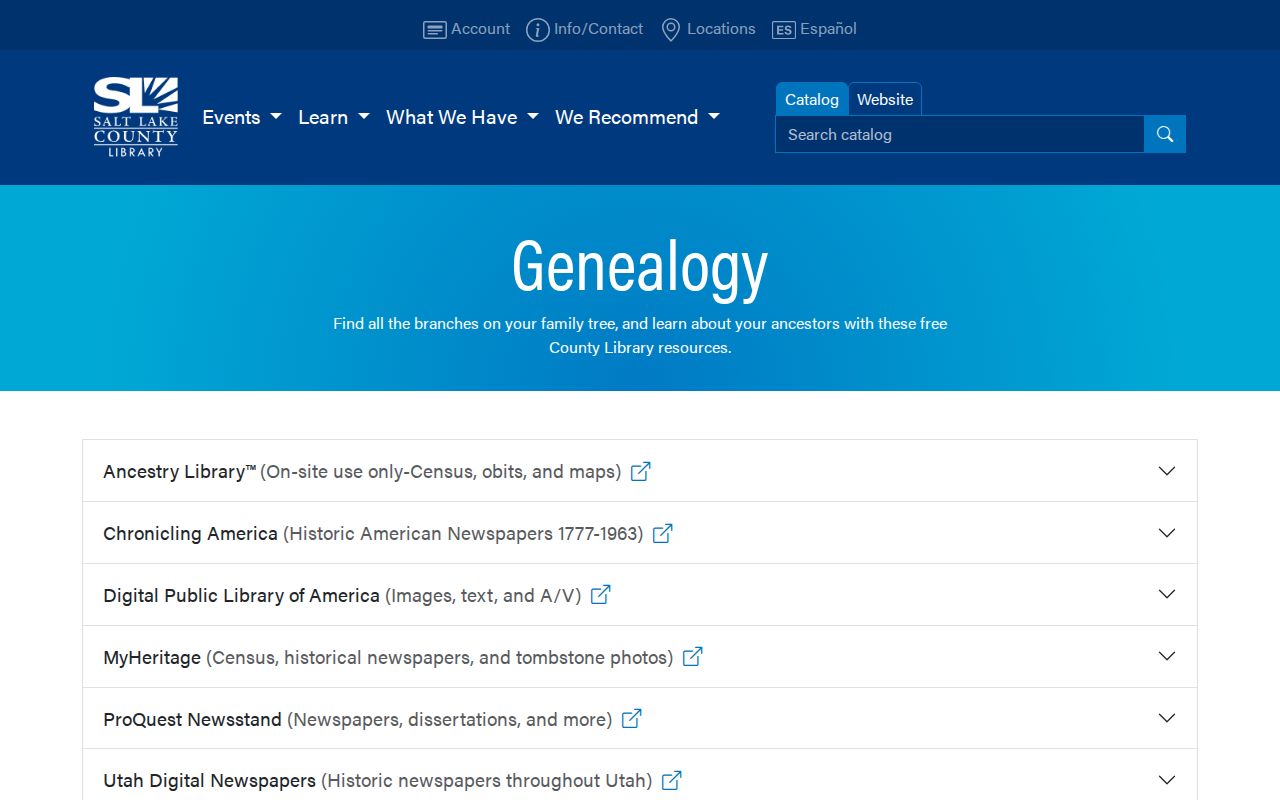
The Salt Lake County Library genealogy page shows the local-history and newspaper research route. Its resource list is a starting point, not a claim that every linked database contains Cottonwood Heights residents.
Archives Behind the Printed Books
Salt Lake County Archives adds historic births, deaths, marriage licenses, tax appraisal cards, land certificates, deeds, plats, maps, proof-of-residence records, planning minutes, and case files. Its house-history guidance says Archives can verify a build year and explain assessment cards, while the Recorder remains the route for previous owners. Older cards can show street number, stories, additions, rooms, depreciation, garage, appraisal date, and a footprint sketch.
Utah Historical Society collections hold books, manuscripts, photographs, architectural material, maps, newspapers, and directories. Sanborn maps cover Utah cities from 1898–1969, but a Cottonwood Heights-specific sheet was not located in the research sweep. Use a map only when the collection proves the place and sheet. Search the County Archives and Utah State Archives by agency and series when a directory points to a public event.
Older Names in Cottonwood Heights Directories
The record’s place label may be the key. Before the 2005 incorporation, older entries can say Salt Lake County, Holladay, East Millcreek, suburban Salt Lake, Butlerville, or a subdivision. Greenfield Village, Cottonwood Ridge, Steffensen Heights, Virginia Hills Drive, Bywater Park, Apple Valley, Greenfield Way, Antczak Park, and Crestwood Park are useful terms from city history and walking-tour material.
Search a directory name beside the subdivision, then test the address against a plat or tax card. Cottonwood Ridge was platted in December 1953 along Virginia Hills Drive. That does not prove a directory entry belongs to the present city, but it gives a concrete bridge between an older page and modern geography.
A Short Local Records Timeline
Cottonwood Heights history has two clocks: the community clock and the records-technology clock. The Community Council dates to 1952. Subdivisions grew during 1953–56. Whitmore Library opened in 1974. The city incorporated January 14, 2005. These milestones explain why a directory, tax card, census page, and city packet can describe the same ground with different names.
- 1894–95: the earliest confirmed Salt Lake Polk directory item in the digital collection.
- After 1924: the UHS Research Center documents address “pink pages” in Polk volumes.
- 1950: the latest public individual census band used for household pairing.
- 2005: Cottonwood Heights municipal records begin with incorporation-era government.
- 2026: Archives indexes and the Recorder digitization project continue expanding discovery.
The timeline is a search aid. It does not turn a nearby Salt Lake volume into a guaranteed city directory.
OCR Is a Finding Aid
Digitized pages make old city directories easier to reach, but OCR can misread a surname, street number, or abbreviation. Search a likely name with spelling variants, inspect the scan, and capture the page or image identifier. The 1894–95 McKimmins and Ness examples show how relationship notes, trade terms, and shared addresses can be useful while still needing corroboration.
When a directory line matters to family history, compare it with Utah Digital Newspapers, the County Archives death index, a deed, tax card, or census entry. A single annual line should remain a dated clue.