
Sources for Cottonwood Heights Address History
Previous residents are found by layering sources with different coverage. Deeds prove legal transfers. Directories and census schedules can show an occupant or household at a date. Tax cards explain a property’s physical changes. City planning files and permits add public project events. The table marks the era and the kind of evidence each source can provide.
| Source | Years It Covers | Where Held | What It Shows |
|---|---|---|---|
| Recorder index and deeds | Exact online cutoff not stated; permanent books | Salt Lake County Recorder | Grantors, grantees, legal transfers |
| Reverse directories | Post-1924 method documented | UHS Research Center | Dated address associations |
| Salt Lake city directories | 1894–95, 1898, selected 1917–83 | UHS digital collection | Names, streets, trades, context |
| Federal census | 1790–1950 public under 72-year rule | NARA and library databases | Dated households and addresses |
| Archives tax cards | 1970s–1991 cards; property series 1853–2021 | Salt Lake County Archives | Build and assessment clues |
| City permits and planning | 2005-present city records | Cottonwood Heights | Applicants, projects, dates |
Start with the Recorder for a legal ownership question, directories or census for an occupant question, and Archives for the age or physical history of the property. The Recorder’s exact online cutoff was not located, so office books and copy requests remain part of the older-record route.
Trace Past Owners Through the Salt Lake County Deed Chain
Begin with the current Assessor parcel, not an unverified name. Save the parcel number, situs and mailing addresses, legal description, subdivision, lot/block, and year-built field. In the Recorder index, locate the instrument that conveyed the parcel to the current grantee. Search that grantor as an earlier grantee, then continue backward while the legal description still matches.
- Pull the current owner, parcel, legal description, and address fields from the Assessor.
- Find the current grantee’s conveyance in the Recorder index.
- Read the grantor, legal description, instrument type, date, and recording key.
- Search that grantor as a prior grantee and repeat backward.
- Use plats, older books, office research, or a copy request when the online trail stops.
- Grantor / grantee
- The grantor transfers an interest; the grantee receives it in the recorded instrument.
- Chain of title
- The linked record of conveyances that connects one legal owner to an earlier one.
- Legal description
- The formal land identity in a deed or plat, more reliable than a changed street label.
Past Households in Directories and Census Records
Ownership is only one layer of previous residents. Post-1924 Polk directories use address “pink pages,” while earlier books may need a name-section search. Pair a 1919 or 1920 directory with the 1920 census, and use 1950 material with care because annual directories and census enumeration dates differ. Salt Lake County, Holladay, East Millcreek, and subdivision names can be more useful than Cottonwood Heights.
The Utah City Directories Collection confirms Salt Lake runs from 1894–95, 1898, selected 1917–32 years, and later selected volumes through 1983. It does not guarantee a Cottonwood Heights-specific run. The collection method is covered on the Cottonwood Heights city directory page. Obituaries, the 1847–1949 death index, probate case history, and later deeds can explain a household’s disappearance or an estate transfer.
Lawful use. Previous-resident research in Cottonwood Heights is for house history, family history, and personal curiosity. Do not use an old record to track, stalk, harass, threaten, or harm a living person.
Bridge Estates, Trusts, and Splits
A chain may move from a person to an estate, trust, corporation, or spouse. Probate case history and an obituary can explain why. A subdivision replat, parcel split, release, or changed legal description can also break a simple address search. Use a recorded plat and adjacent lot references to bridge the change, and do not treat a seller’s name as proof that the seller lived at the property.
The Recorder public search is informational and its exact online historical cutoff was not found. Data Services offers paid packages, while ordinary and historical copy requests use separate page fees. Older index books and office research remain necessary when the digital path ends.
Use Tax Cards to Date the House
Salt Lake County Archives describes property and tax records from 1853–2021 and holds 1970s–1991 tax appraisal cards. Older cards can show frontage and street number, stories, additions, square footage, rooms, garage, year built, depreciation, appraisal date, and a footprint drawing. Current 2000-present tax records route to the Treasurer. These fields can date a building or change, but they do not name every occupant.
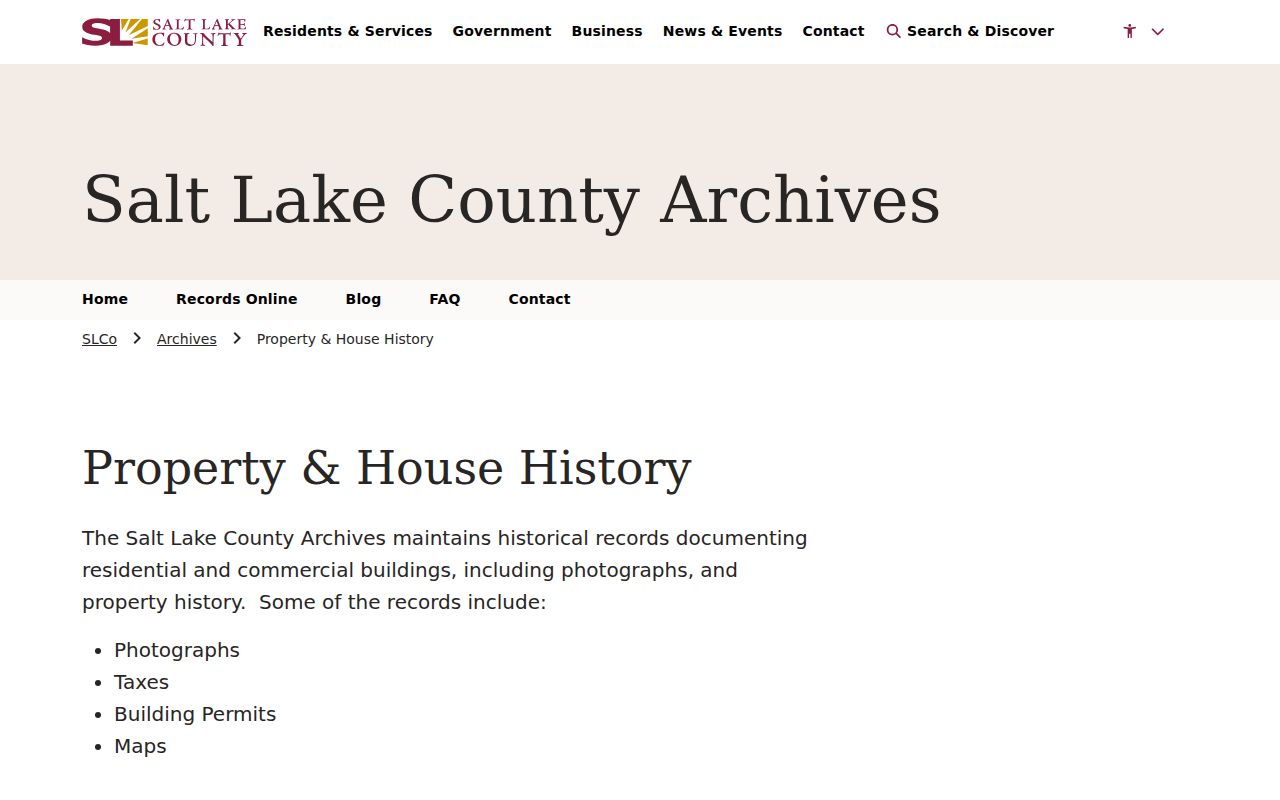
The Salt Lake County Archives house-history guide shows the property-history route. It points current ownership to the Assessor and previous owners to the Recorder.
Cottonwood Ridge as a History Bridge
Cottonwood Heights’ first subdivisions provide concrete search terms. Greenfield Village, Cottonwood Ridge, and Steffensen Heights developed in the 1953–56 period. Cottonwood Ridge was platted in December 1953 along Virginia Hills Drive. Use those names in plats, newspapers, tax cards, and early planning records when the current city name returns nothing.
The city’s history also identifies Butlerville, Bywater Park, Apple Valley, and other place clues. A 1950 census record can sit in Salt Lake County while a later deed uses a subdivision lot and block. The bridge is the legal description, not a modern ZIP or city label.
Obituaries and Probate Close the Trail
Death and estate records can explain why a household disappears from a directory or why a deed changes hands. Salt Lake County’s historic death index covers 1847–1949 and searches first name, last name, year, parents, and name variants. Utah Digital Newspapers and Whitmore Library add notices and family context. Probate case history can identify a decedent, heir, fiduciary, or petitioner, but filings may be private or redacted.
Use an obituary as a lead, then check the death index, probate role, and deed transfer. Keep a dated description such as “historical directory entry” or “estate transfer,” not the broader claim that a person lived at the house.
Keep an Evidence Ledger
A previous-residents search is easier to audit when every step gets one row. Record instrument number, recording date, document type, grantor, grantee, legal description, parcel number, volume/page, image or office-copy route, and why the document matches. Keep the street label separate from the legal description.
- Save the current Assessor parcel and both address fields.
- Quote the Recorder’s legal description and recording key.
- Mark whether a name is owner, grantor, grantee, trustee, estate, or representative.
- Use a dated directory or census entry for occupant context.
- Write down every unresolved jump instead of filling it with an assumption.
The Salt Lake County grantor-grantee search route illustrates the index path for working backward from a deed. Match every result to the parcel’s legal description.
The Address-Continuity Gap
No official Cottonwood Heights street-renumbering or renaming year was verified. Salt Lake County Addressing says a change is documented by affidavit and coordinated with the municipal authority. Search the current standardized address, older subdivision or street form, historical jurisdiction, plat, and legal description.
A missing address match can reflect a changed label, parcel split, replat, estate, or trust. Leave the gap visible until a record bridges it.
Watch the Recorder Digitization Project
Salt Lake County lists a Recorder-led historic property-record project with $85,000 in funding to convert more than a century of paper records to searchable digital records. The project remains in progress. It may improve access to prior-owner material, but no final online cutoff was posted.
Record the portal date and image status whenever a newly digitized deed is used. The current absence of an online year is a research gap, not evidence that the deed does not exist.
Write the House History in Order
Keep a timeline with deed date, transfer type, name role, legal description, directory year, census year, tax-card clue, and supporting newspaper or probate item. A clean timeline can show where ownership and occupancy overlap and where they do not.
The County Archives property-history page is the local starting point for build-year and assessment-card research. Use the current parcel as the anchor, then stop when the evidence becomes only a historical association.